Olga Kondratova
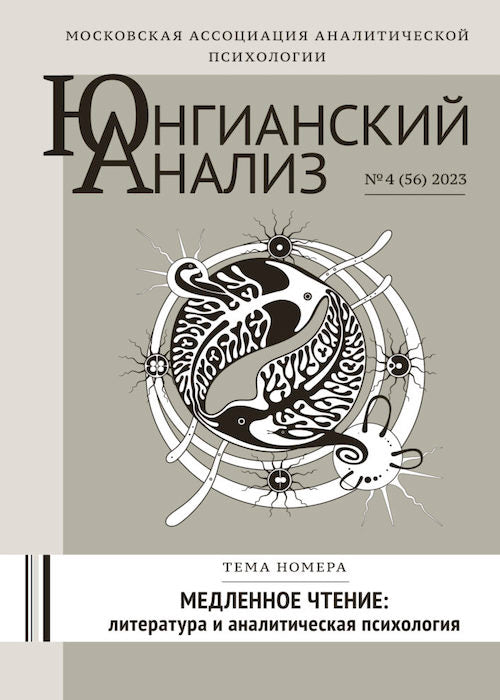
YA No. 4 (56) 2023 Slow Reading
YA No. 4 (56) 2023 Slow Reading
Couldn't load pickup availability
Introduction
The leading melody of this issue is literature as the predecessor, the elder sister of analytical psychology. Their kinship is obvious but rarely acknowledged and named. And if so, then reading is also analytical work with all its ups and downs, positive and negative countertransference, transformation, and ultimately individuation. This is where the authors—the first violins setting the theme of the issue—lead us. Christian Gaillard reflects on Jung's view of art, explaining that Jung teaches us to treat art like dreams, not being interested in the text's origin from the author's biography, allowing the text and the work of art to pass through the soul of the reader/viewer. He talks about Jung's acknowledgment and acceptance of his negative countertransference in confronting Joyce's text, about how to allow the "subterranean current of life" (the unconscious) to involve oneself in the process of psychic creation, despite resistance and fear of destabilization.
For a better understanding of this approach to literature, Susan Rowland proposes a method of close reading based on active imagination and experiencing the text in contact with the symbol, when the text is allowed not to address readers, but to speak through them. Only then can transformation happen, and this, according to the author, is akin to magic.
In the next three articles, Jung is presented as if from the outside, seen through the eyes of other people. The first essay about meeting Jung was written by H.G. Wells, and the second by Wells' biographer Vincent Brome, who observed them together. Also included are excerpts from Miguel Serrano's diary, who recorded the dialogue between Hermann Hesse (Jung's client) and C.G. Jung. The miracle is that Serrano was not a witness to this dialogue — he restored it, completed it, or invented it. Let's treat this as a kind of dream, and "a dream never says 'You ought to' or 'This is true.' It presents an image almost in the same way that nature allows a flower to grow, and it is up to us to draw conclusions" (Jung).
Next, we are given the opportunity to practice what we have learned. The largest section of the issue consists of articles related to Russian and Japanese literature, where the focus is on the path of individuation through collective and individual traumas and complexes.
Alexander Etkind focuses on cultural traumas and turns to the works of post-Soviet writers—primarily Pelevin, Sorokin, and Bykov, drawing on Freud's essay "The Uncanny." The image of the triton plunges us into the uncanny: in Solzhenitsyn's novel "The Gulag Archipelago," prisoners carved out a prehistoric triton from the permafrost and ate it. In the same way, the aforementioned authors thaw the permafrost of trauma, saturate their works with "tritons," and revive the monsters of the past.
Japanese cultural traumas become a prism for analyzing the individuation of the protagonist in Haruki Murakami's "Rat Trilogy," which Irina Tertitskaya explores. She thoroughly investigates how the hero, over the course of four novels (and only the fourth, "Dance, Dance, Dance," allowed the author to complete the trilogy), progresses from individualism to individuation.
A similar work is performed by the protagonist of F.M. Dostoevsky's novel "The Adolescent," whose inner landscape is filled with Russian cultural complexes. Maria Loseva examines the images of birds in "The Adolescent" and discovers their symbolic connection with the hero's inner archetypal images—mother, father, etc. By humanizing them, the Adolescent traverses his path to maturity.
This section concludes with Elena Fedorovskaya's work, which directs us to Japanese haiku culture and its therapeutic possibilities. The author reminds us of the symbolic potential of any culture and how we can rely on it in complex individuation processes.
Elena Purtova's concluding essay about her journey through Mongolia consists of sketches observing how the landscape affects the inner state of the soul. Just as close reading allows the text to pass through the soul, so "close looking" allows the landscape to permeate the viewer and provide an amazing experience of harmony with that very "subterranean current of life."
Contents
Jung's Literary Image
Herbert Wells. On Carl Gustav Jung
Vincent Brome. Herbert Wells and Carl Gustav Jung
Miguel Serrano. Jung and Hesse: An (Un)Met Encounter
The Art of Reading
Christian Gaillard. Art
Susan Rowland. Reading Jung for Magic: Active Imagination in "Close Reading"
Images of Individuation in Two Cultures
Alexander Etkind. The Return of the Triton: Soviet Catastrophe and Post-Soviet Novel
Irina Tertitskaya. The Path from Individualism to Individuation in Haruki Murakami's "Rat Trilogy"
Maria Loseva. The Boy with the Bird
Elena Fedorovskaya. The Use of Haiku in Jungian Psychotherapy
Spiritual Journeys
Elena Purtova. Mongolia as Meditation
Share