Olga Kondratova
JA No. 3 (55) 2023 Emigration
JA No. 3 (55) 2023 Emigration
Couldn't load pickup availability
Introduction
A passing rumor brought
Sweet, unnecessary words:
Summer Garden, Fontanka, and Neva.
You, foreign words, where are you going?
Here, strange cities bustle
And strange waters splash.
You cannot be taken, hidden, or driven away.
One must live, not remember,
So that it doesn't hurt again.
Not to walk through the snow to the river,
Hiding cheeks in a Penza shawl,
A mitten in Mama's hand.
It was, it was, and it's gone.
What's gone — the blizzard has swept away,
That's why it's so empty and bright.
Raisa Bloch, 1932
Emigrants, immigrants, repatriates, relocants, displaced persons, returnees and non-returnees, migrant workers... And who are you? Migration is the fate of almost everyone. Not many people are born and grow old in the same city, district, house, apartment. "I've been evicted from Arbat, // An Arbat emigrant, // In Bezbozhny Lane // My talent wilts. // I've been expelled, lost // Among other people's destinies, // And bitter is my sweet, // My emigrant bread" – Bulat Okudzhava wonderfully accurately conveyed the feelings of a migrant who has lost identity and connection with the potential of the unconscious along with space.
Why does this happen? Renos Papadopoulos explains that the loss of home creates a breach in the psyche, while having a home helps to hold opposites together, resisting splitting. Deprived of a home, a person is also deprived of an inner home and then deals with where they ended up – between a destroyed home and a new home that has not yet appeared, in the territory in between, in the territory of losses and suffering. Psychiatrist and psychologist Joseba Achotegui, founder of a psychological service for refugees and migrants, explores the specifics of modern migration and proposes to call the suffering they experience the "Ulysses syndrome."
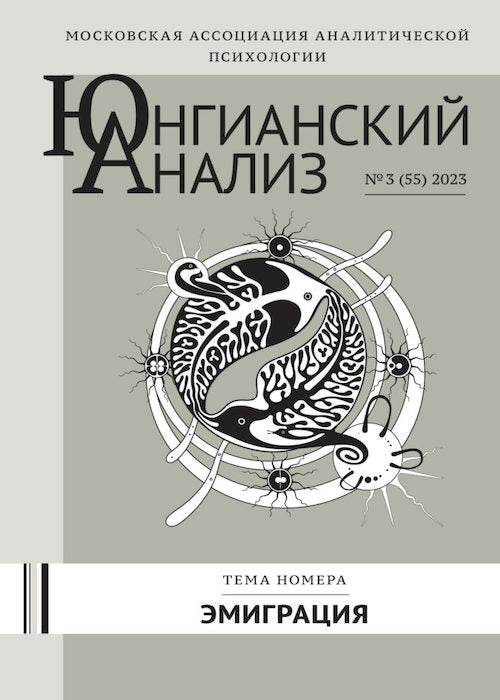
In this issue, we tried to explore various aspects of emigration: suffering and transformation, past and present, historical and symbolic, personal and therapeutic experience.
Yulia Kazakevich amplifies the story of Lot and traces the connection with numerous mythological plots embodying various parts of the psyche, comparable to Papadopoulos's "breach." Viviane Thibaudier examines images of a lost homeland in the psyche of descendants of emigrants. In clinical vignettes, she observes the surfacing memory of exile, which consumes a part of psychic energy.
It is important to keep in view both the loss and the productive, creative side of the exchange with the new homeland. Thus, Teresa Aiello discusses the emigration of European psychoanalysts to America and their exceptional influence on the development of American psychiatry and psychoanalytic practice.
Three colleagues who moved to France and work with immigrants (C. Binet, L. Caldera, E. Franzini-Soria) share their own emigrant experiences and the stories of their clients, reflecting on a newly assembled identity – similar to Harlequin's costume sewn from various scraps. Anna Fonareva talks about her work with current wave emigrants, and Christophe Le Meur describes the internal dream process that helped him cope with moving to another country.
But why do significant groups of people choose to lose their home? Sergey Morgachev explores the image of Hecate, arguing that she is also the goddess of choice between light and darkness, symbolizing one of the most important functions of the human psyche – to be in between, to make choices. But not everyone signed up for "being in between"; often the choice is made not by the person themselves but by circumstances. Elena Purtova examines the five waves of Russian emigration as unconscious layers of the collective psyche influencing each of us: this is how the history of the country, clan, and family lives within us, and it affects everyone's choice – to leave or to stay, to make one's emigration literal or symbolic. And then – to look back, like Lot's wife, to violently conquer one's future through sin, like their daughters, to atone for one's sin, like Lot himself.
Maria Loseva, Elena Purtova
Contents
Point of View
Sergey Morgachev. Hecate, Goddess of Crossroads
Elena Purtova. Social Catastrophes and the Loss of Homeland
Home and Loss of Home
Renos K. Papadopoulos. Refugees, Home and Trauma
Joseba Achotegui. The Intolerable Grief of Immigration: Ulysses Syndrome
Personal Experience
Teresa Aiello. Psychoanalysts in Exile
Carline Binet, Luis Caldera, Elaina Franzini-Soria. Encountering the Other: Within Oneself, Between Oneself, and in the World Around Oneself. Harlequin and Persona.
Christophe Le Meur. The Necklace of Numbers
Archetypes and Mythological Images of Emigration
Yulia Kazakevich. Emigration and Paths of Transformation
Viviane Thibaudier. If I Forget Thee, Jerusalem
Anna Fonareva. Emigration: In Search of Lost Foundations.
Share