Introduction
Leaving the dungeons of life,
Your soul ascends
To the doors of an imaginary paradise,
To unattainable realms.
Eternal visions greet
Its swift flight,
And the clear cold of inspiration
Creates crystals from dreams.
But when, returning to Earth,
Concealing the incomprehensible,
It awakens, immersing itself
In the misty air of being, —
A heavenly ray of memories
Suddenly flashes within it
And the dark gloom of human suffering
It will cut through with its lightning.
Fyodor Sologub's poem figuratively, yet concisely, one might say schematically, outlines the creative process as a departure and subsequent return with acquisitions that heal human suffering. In psychological terms, Stefan Wolff, one of the authors of this issue, said much the same: "Art, like psychoanalysis, aims to achieve a representation of the unrepresentable, that is, to allow the unnamed to be named, the invisible to become visible, the unheard to be heard, the unthinkable to become thinkable."
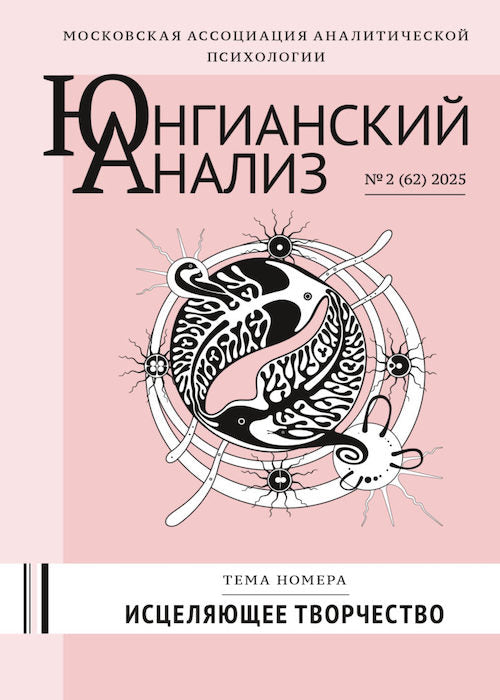
The theme of this issue is healing creativity. This is far from the first issue dedicated to the analogy between psychological work and the creative process. What distinguishes it from previous ones is a special, extremely profound look at how this all happens and what one can bring back from there into the "misty air of being." What is creativity? And how can it heal? Is creativity always individuation? And what happens if one doesn't respond to the call of creative impulse? Of the unseen, the never-before-existing self. Can this be called self-transformation?
Is creativity always individuation? And what happens if you don't respond to the call of the creative impulse? And how do we pay for engaging in creativity instead of something else?
The authors of the issue examine creativity in the contradictoriness of its properties. They analyze the personal origins of creativity: for example, separation from his mother and the severity of family rules shaped Ingmar Bergman's unique inner world and served as the source of his films, while Maria Callas's creativity is linked to her ability to lend her unique voice and experience of suffering to embody the archetypal energy of tragic female figures.
Natela Beridze reflects on Virginia Woolf and draws attention to a rarely noticed aspect of the creative process — sublimation, which allows the "creator" to avoid the pain and suffering of individuation through regression. Maria Fedyunina also reflects on the inner challenges of the Animus at the crossroads of a woman's individuation process.
Much in this issue is connected precisely with women's creativity. From a historical perspective, women have not been involved in creativity for all that long. Childbirth is also creativity, but that is a different, literal edge of it. And Janice Shapiro, describing her brainchild—a studio for adolescents undergoing treatment in a psychiatric hospital—considers this place a midwife, accompanying the new birth of a child.
Anna Bolsunovskaya discusses the genre of autofiction. The creator of this genre, Serge Doubrovsky, called it "fiction of the authentic," and we find an aspect of writing that is still unfamiliar: how the text changes its creator. Such self-generation (or self-rebirth) is also a beautiful image, because here the creation of an unseen, never-before-existing self takes place. Can this be called self-transformation?
Maria Loseva, Elena Purtova
Contents
Point of View
Stefan Wolff. "Routine is a Dead End" (C.G. Jung): On the Similarity Between Artistic-Creative and Psychoanalytic Work
Christian Gaillard. Jung, Picasso, and the Color Blue (Part 1)
Sources of Creativity
Maria Fedyunina. Animus and Eros: Creative Challenges of the Modern Woman
Natela Beridze. The Dangers of the Creative Process
Svetlana Lebedeva. Maria Callas: Voice as a Cure for Pain
Anastasia Parfenova. Ingmar Bergman. Cinema as a Way to Interact with Early Trauma
Self-Creation
Janice Shapiro. The Open Studio as a Creative Intercultural Community. All Islands Connect on the Seafloor
Anna Bolsunovskaya. How to Write Yourself
Life with Mana
Sergey Morgachev. Project "Life with Mana". Editor's Introduction
Pan Lemos. The Radiance of Telesphorus: A Brief Reflection on the Term "Mana-Personality" and the Dynamics of the Experiences Behind It