Olga Kondratova
JU No. 1 (61) 2025 Mutism
JU No. 1 (61) 2025 Mutism
Couldn't load pickup availability
Introduction
My voice resembles a headdress.
Or rather, my voice resembles a headdress.
Or rather, it seems that a throat surge
bristles the fur on my earflap hat.
The superstructure of speech above my mind
is loftier than the laces on myself,
loftier than a soft little animal,
a shoelace tied in a bow.
I. Brodsky.
“My voice resembles a headdress…”
1960s
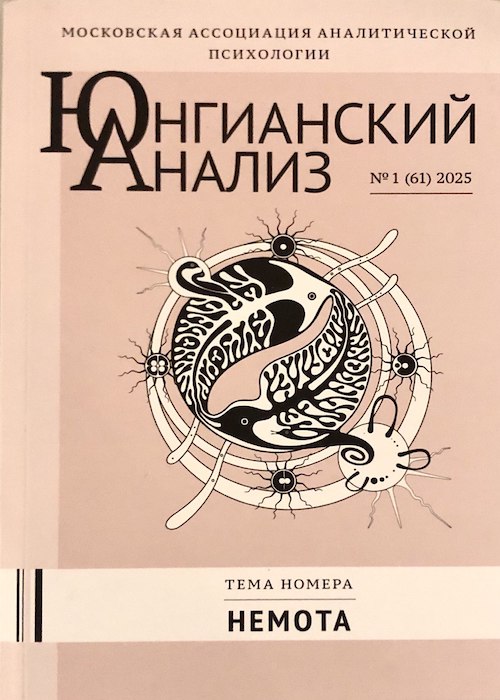
Voice is a topic of incredible significance; the entire psychic life of a person is permeated by voices, both sounding and silent: the clear voice of consciousness and the whisper of the unconscious, which sometimes drowns out consciousness, all accompanied by the hum of the collective unconscious. But what about a lost voice? The authors of this issue reflect on stuttering children, on children who do not speak and those who once fell silent. Refusing to speak can be compared to the story of Andersen's Little Mermaid, who lost her voice not only "because," but for something more important to her. Françoise Caillet discusses early relationships with the mother, when the child cannot avoid the discrepancy with her fantasies about him and slips out of this safe identification, hovering over an abyss — between his bad and good self, between a bad and good mother, and between mother and father. Silence often affects loved ones more powerfully than speech — parents who bring their children to psychologists and speech therapists keenly feel this. And together with them, we carefully observe and listen to the screaming silence of several children, reflecting on its meanings and messages in articles by Ekaterina Zaostrovtseva, Elena Dugina, Oksana Korepanova, and Olga Neshina.
Stuttering children can also be understood as being caught in an internal conflict, thereby exerting strong pressure on loved ones. As logotherapist Yulia Lototskaya-Kettani notes, their functioning “can be described as floating, resembling an elusive mercury ball that changes its mass and form.” Speech therapist and psychoanalyst Annie Anzieu explores typical personality traits of stutterers and connects them to entering the Oedipal conflict and an internal prohibition on expressing unacceptable desires, which are masked by stuttering. Trapped by his impulses, “the subject remains at a sufficient distance from the imaginary realm” and finds no symbolic resolution to his conflicts. And what fills the silence of autistic children? Francesco Bisagni believes that they are immersed in a deafening silence and lack singing mothers. And Lydia Ruonala compares children with ASD to the Ocean of Solaris from Stanisław Lem’s novel “Solaris,” which communicates with Earthlings in a language understandable only to itself, and this is an excellent example of neurodiversity. Thus, we conclude that the main conflicts of child development are concentrated in the theme of voice. And in a truly astonishing article by Ivan Fonaghi, we discover a bold comparison of speech sounds with the phases of psychosexual development — oral, anal, phallic. After reading this article, one understands that it is impossible to hide feelings with the voice — it will inevitably give them away… And our job is to listen and, as Bisagni suggests, to offer clients our singing psyche.
Maria Loseva, Elena Purtova
Content
Point of View
Françoise Caillet. The Development of Shadow in Childhood.
Lydia Ruonala. “I’m talking to you, just from another dimension.”
Francesco Bisagni. Sounds of Silence. The Role of Musicality in Autistic Conditions
Psychoanalysis of Speech Development
“Some children talk, others don’t.” Interview with Annie Anzieu.
Annie Anzieu. On Some Personality Traits of the Stutterer.
Yulia Lototskaya-Kettani. Preliminary Psychoanalytic Study of the Stutterer’s Personality.
Oksana Korepanova. In Search of Speech
Ivan Fonaghi. The Connection Between Drives and Sound Production.
Trauma and Loss of Speech. Cases
Ekaterina Zaostrovtseva. “Grandma Has a Cat and a Turtle”
Olga Neshina. Speech Delay as a Manifestation of Childhood Psychological Trauma.
Elena Dugina. Eloquent Silence.
Share