Olga Kondratova
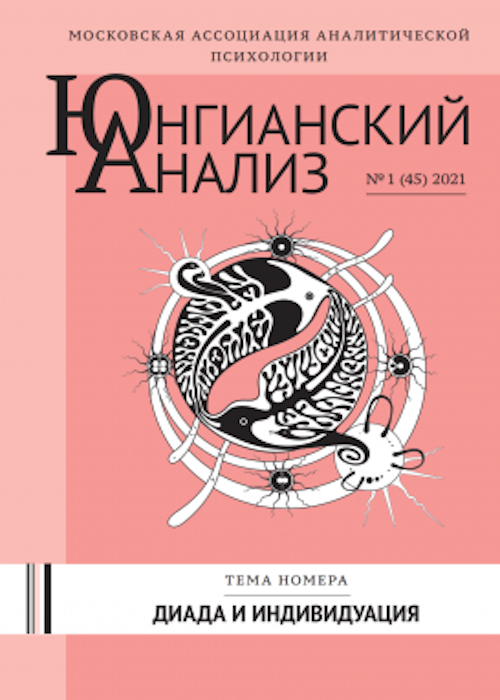
JS No. 1 (45) 2021 Dyad and Individuation
JS No. 1 (45) 2021 Dyad and Individuation
Couldn't load pickup availability
Introduction
The issue you are holding is dedicated to the memory of the recently departed Alessandra Cavalli, who did so much for the establishment of child psychoanalysis in Russia. You will read about this in detail in the essays by Elena Bortuleva and Maria Salyamova. The theoretical significance of her work is reflected in the second IAAP International Conference on Child Analysis dedicated to her, an overview of which you will also find here. Perhaps one day her book will be published in Russian, but for now we are very proud to be able to continue publishing Alessandra Cavalli's works and offer three articles in which she skillfully combines various theoretical lines on child development with Jung's idea of individuation. Thanks to them, readers' theoretical baggage will be enriched with new concepts reflecting transitional phenomena: caesura and marsupial space. One could say that Alessandra herself created a marsupial space in Russia for child analysts, supporting their entry into the international community.
Further research into Bionian ideas will be seen in the works of Martha Harris on how infants and mothers learn to create a connection, Elena Kosheleva on experiencing understanding and misunderstanding in the therapeutic process, and Raisa Dairova on intra-family ways of coping with emotions during the pandemic.
From complex Bionian theoretical constructs, we move to the "Practice" section, where Maria Gudush reflects on the optimal period for weaning, and Lyudmila Shushkovskaya shares her experience of creating psychotherapeutic fairy tales in her work with children and adolescents, which transport her clients to the right place.
And finally – particularly striking works by Alessandra Cavalli's students, which precede entry into the issue, two presentations from recent MAAP conferences. Victoria Andreeva analyzes the cultural traumas of parenthood in our country – from the early twentieth century to the millennial generation, an experience filled with broken connections, leading to the fear of modern parents of traumatizing their child. Elizaveta Molostova analyzes the specifics of supervision in child analysis, which we can consider as a symbolic marsupial space for growing professionals.
We hope that the authors' theoretical generalizations and the rich illustrative material of cases and vignettes will contribute to your professional growth, dear readers!
Maria Loseva, Elena Purtova
In this issue:
Point of View
Victoria Andreeva. The cultural complex of child-parent relations in the post-Soviet space
Elizaveta Molostova. The supervisory pair: an inside and outside view
In Memory of Alessandra Cavalli. Early childhood experience and individuation
Elena Bortuleva, Maria Salyamova. In Memory of Alessandra Cavalli
Elena Bortuleva. Traditions – innovations – traditions. The Second IAAP International Conference on Child Analysis
Alessandra Cavalli. Childhood: continuity of development or experiences of becoming
Alessandra Cavalli. Clinging, grasping, holding, containing: reflections on the survival reflex and the development of the capacity for separation.
Alessandra Cavalli. Identification – an obstacle to individuation or how to become oneself
Reverie and Bion's ideas in child analysis
Martha Harris. How to learn from the experience of childhood and infancy.
Elena Kosheleva. Between understanding and misunderstanding: experiencing K and -K in the therapeutic process
Raisa Dairova. A psychoanalytic perspective on family life during the pandemic
Workshop
Maria Gudush. Possible consequences of "long-term breastfeeding."
Lyudmila Shushkovskaya. Fairy tale therapy in analytical work with children and adolescents
Peter Blake. Working with parents
Share