Olga Kondratova
JA No. 3 (59) 2024 Libidinal Energies in Old Age
JA No. 3 (59) 2024 Libidinal Energies in Old Age
Couldn't load pickup availability
Introduction
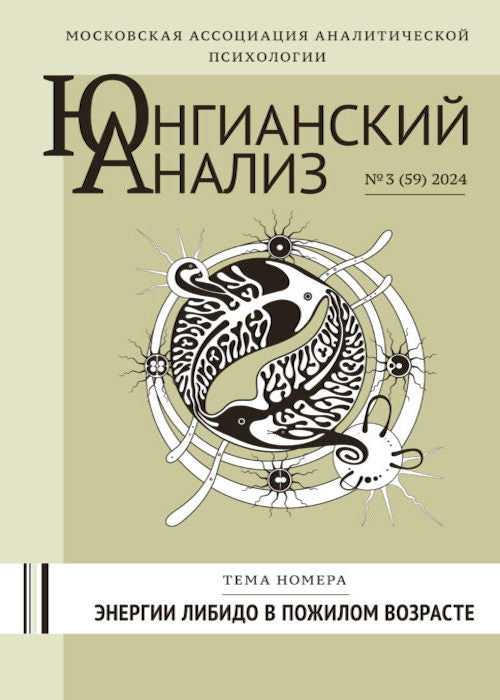
Ingrid Riedel, speaking of old age, compares it to the last fifteen minutes in a card game: as a rule, it is they that determine the outcome of the entire game. In this issue, we try to understand the secret of old age, which can give a feeling of winning and appropriating that win in life.
The discovery of the inner content of individualized and energetic libido flows makes old age a more understandable and less frightening part of life’s journey. For many, it becomes a more interesting and peaceful time than childhood and youth. For example, in one of the chapters of the book “Inner Freedom of Aging,” Ingrid Riedel recalls Bertolt Brecht’s wonderful story about a widow who suddenly dared to live the last allotted time as she wished. Svetlana Niskulova’s captivating story about the life of the poet and singer Leonard Cohen can be called a journey from the very (talented, successful self) to the Self (meeting and agreement with the Almighty).
The articles in the “Problem of the True Self” section pick up the theme of the issue: Carter Heynes explores themes of psychology and spirituality for application in pastoral practice and spiritual guidance, while David Ho reveals the resources of Eastern concepts of Self and identity. The theme of Sergei Morgachev’s article does not seem related to old age but belongs precisely to it: not naive elders, but wise men are fascinated by the sacred and shamanistic side of science.
Many authors in this issue turn to personal experience and generously share their own stories. Sondra Geller talks about her pleasure of working and being friends with older people who fill her childhood deficits; her profession is analysis and art therapy with older people. Claire Allphin’s article resembles Kazuo Ishiguro’s novel “The Remains of the Day,” which tells of a butler who cannot imagine himself as anything but a butler: the author frankly writes about how a psychologist ages and loses former abilities, as his sudden death can interrupt an analysis that has begun.
Daria Goryacheva and Maria Loseva reflect on old age, drawing, among other materials, stories from their own family life, which greatly enlivens the overall landscape of the issue. And Elena Shkadarevich, based on fiction, diary entries, and films, combines the Elder and the Infant into an archetypal pair, highlighting the points of contact between childhood and old age in search of a common meaning and the fullness of individual experience.
Albert Kreinheder, not a naive but a cheerful and witty elder, offers a vivid account of his feelings at 70: various figures come to him, as to Jung — an Indian chief, a puma, etc., and he communicates with them. To conclude the introduction to this issue, I would like to quote his beautiful observation about what old age knows that youth does not: “Holes appear in the Ego, the unconscious seeps out and saturates the entire spectrum of our conscious perception.”
Maria Loseva, Elena Purtova
Contents
Sondra Geller. Rekindling the Spark of Creativity in Older Adults
Daria Goryacheva. “Old Age is Included in the Creator’s Project.” Reflections on topics of old age
Albert Kreinheder. Images of Aging
Maria Loseva. The Future of Old Age
Sergei Morgachev. The Seal of the Hidden
Svetlana Niskulova. “I Heard There Was a Secret Chord”: Leonard Cohen’s Four Lives”
Claire Allphin. Where Does Analytic Identity Go When Aging Intervenes?
Ingrid Riedel. The Inner Freedom of Aging
Carter Heynes. Identity, Transcendence, and the True Self: Views from Psychology and Contemplative Spirituality
David I.F. Ho. Self and Identity in Eastern Religions: A Contrast with the West
Elena Shkadarevich. The Wise Infant – The Naive Old Man
Share